Khyber Pakhtunkhwa Ramadan Relief 2026
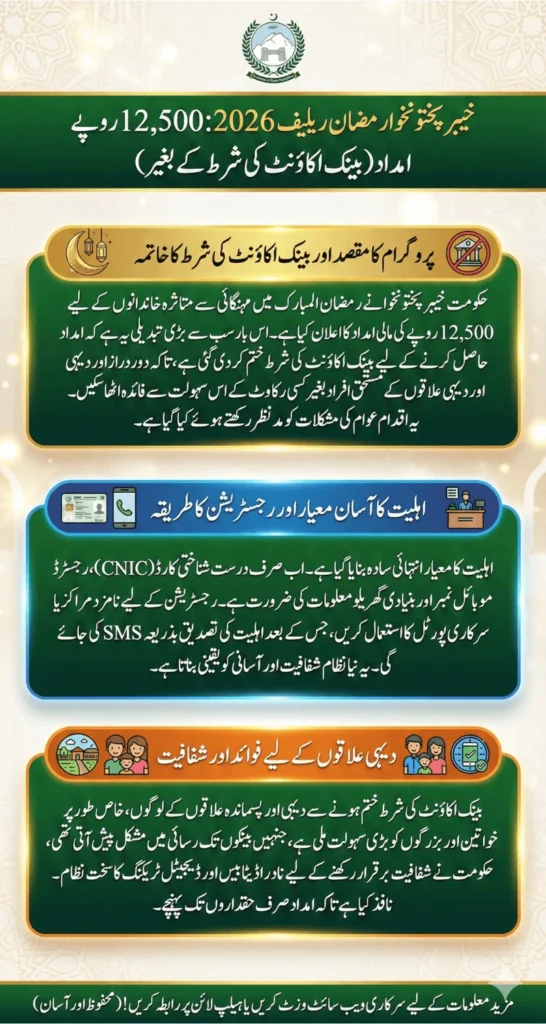
Khyber Pakhtunkhwa Ramadan Relief 2026 Rs 12,500 Aid Without Bank Account is a major welfare initiative introduced to support financially struggling families during the holy month. The provincial administration of Khyber Pakhtunkhwa has redesigned the relief distribution system to remove the earlier bank account condition. This reform ensures that deserving households, especially those in rural and remote areas, can access financial support without facing unnecessary banking barriers. The assistance amount of Rs12,500 per family aims to ease the burden of rising food prices and household expenses during Ramadan. The latest update reflects a people-focused approach where accessibility and fairness take priority over procedural complications.
Also Read: CM Punjab 10000 Ramzan Package 2026 CNIC Verification & Payment Process
Purpose of the Ramadan Relief Initiative 2026
Ramadan often increases household expenditures due to higher food consumption, charitable obligations, and utility usage. For low-income families, these additional costs can create serious financial pressure. Recognizing these challenges, the KP government introduced the 2026 Ramadan Relief package to provide direct cash support. The objective of this program is not only short-term financial assistance but also social protection. By offering Rs12,500 to eligible families, authorities aim to ensure that vulnerable households can meet their essential needs with dignity. The initiative particularly targets daily wage earners, widows, laborers, and families with limited income sources. The program also aligns with broader poverty alleviation efforts designed to promote economic stability across the province.
Removal of Bank Account Requirement: A Major Policy Shift
Initially, the relief scheme required applicants to possess an active bank account for fund transfer. While digital payments were intended to enhance transparency, the requirement unintentionally excluded many rural households. In several districts of KP, banking infrastructure is either limited or difficult to access. Families often need to travel long distances to reach bank branches. Opening an account also involves documentation and procedural steps that may discourage low-income applicants.
After public feedback and consultations, the provincial administration decided to eliminate this requirement. Now, beneficiaries can register and receive support without submitting bank account details. This decision significantly expands the program’s reach and removes a key obstacle for rural communities. The change demonstrates the government’s willingness to adapt policies in response to citizens’ concerns.
Also Read: How To Check BISP 8171 Payment Status In 2026 Eligibility And Registration Guide
Simplified Eligibility Criteria for Applicants
The revised system focuses on straightforward eligibility conditions. Instead of financial documentation related to banks, authorities now emphasize identity verification and basic household assessment.
Applicants generally need:
- A valid Computerized National Identity Card (CNIC)
- A registered mobile phone number
- Basic information regarding household income and family size
The simplified documentation process reduces complexity and shortens verification time. It also ensures that individuals without prior banking relationships can still benefit from the scheme. Officials have clarified that only genuinely deserving families should apply, as strict screening mechanisms remain in place to prevent misuse.
Registration Process Under the Updated System
The new registration framework is designed to be user-friendly and accessible. Applicants can submit their details through designated registration centers or official channels announced by provincial authorities.
The process typically involves:
- Providing CNIC information for identity verification.
- Submitting a mobile number for updates and communication.
- Completing a basic household profile for eligibility assessment.
After successful verification, beneficiaries receive confirmation via SMS. This method ensures transparency and keeps applicants informed about their application status. By shifting from bank-based verification to CNIC-based authentication, the system maintains accountability while improving convenience.
Also Read: GTS Punjab Phase 3 2026 Complete Online Registration & Eligibility Guide
Benefits for Rural and Remote Communities
The removal of the bank account condition primarily benefits residents of remote villages and underdeveloped areas. Many rural families lack access to formal banking services due to geographical and financial limitations.
Key advantages of the revised mechanism include:
- Equal opportunity for households without bank accounts
- Reduced travel expenses and time consumption
- Faster enrollment and fund distribution
- Increased participation of women and elderly applicants
For families living in mountainous or distant districts, this policy change removes a significant barrier and ensures inclusive participation.
Also Read: CM Laptop Scheme 2026 Private College Students To Receive Laptops For The First Time
Transparency and Oversight Measures
Despite simplifying requirements, the KP government has maintained strict oversight protocols. Identity verification through CNIC databases helps prevent duplicate registrations and fraudulent claims. Authorities are also using digital tracking systems to monitor fund disbursement and ensure timely delivery. Regular audits and administrative supervision aim to safeguard public funds and maintain public trust. Officials have emphasized that transparency remains central to the relief program, even after removing the banking condition.
Financial Impact of Rs12,500 Assistance
The Rs12,500 relief amount provides meaningful support for households struggling with inflation. During Ramadan, families often spend more on groceries such as flour, rice, sugar, cooking oil, and meat. Utility expenses may also increase.
This financial assistance allows beneficiaries to:
- Purchase essential food items
- Manage electricity and gas bills
- Cover other urgent household needs
Also Read: BISP 8171 January 2026 Payment Update CNIC Verification & Eligibility Guide
Comparison: Previous vs Revised Procedure
Below is a detailed comparison between the earlier framework and the updated system:
| Category | Earlier Framework | Updated Framework |
| Banking Requirement | Compulsory bank account | No bank account needed |
| Identification | CNIC plus bank verification | CNIC and mobile number only |
| Accessibility | Limited for rural areas | Inclusive for all eligible households |
| Registration Complexity | Higher documentation burden | Simplified process |
| Beneficiary Outreach | Restricted | Expanded coverage |
The revised procedure clearly reflects improved accessibility and administrative efficiency.
Key Features of Khyber Pakhtunkhwa Ramadan Relief 2026
| Feature | Description |
| Assistance Amount | Rs12,500 per eligible family |
| Target Beneficiaries | Low-income households across KP |
| Required Documents | CNIC and active mobile number |
| Bank Account | Not required |
| Objective | Provide timely and transparent Ramadan support |
These features highlight the government’s commitment to inclusive welfare delivery.
Encouraging Maximum Participation
Provincial authorities have urged eligible families to complete registration as soon as possible. Awareness campaigns are being conducted to inform citizens about the updated criteria and simplified process. Local representatives and community leaders are also expected to assist residents in understanding eligibility guidelines. By promoting clarity and reducing fear of exclusion, the government hopes to ensure that no deserving household misses the opportunity.
Also Read: 8171 BISP Registration 2026 Token Slip, Verification Process & PMT Criteria
Broader Significance of the Reform
The decision to remove the banking requirement sets a positive example of responsive governance. It shows that policymakers are willing to reconsider administrative procedures when they create unintended barriers. This reform not only benefits Ramadan 2026 applicants but may also influence future welfare programs in the province. Inclusive design and citizen feedback can strengthen the effectiveness of social protection initiatives. By prioritizing accessibility alongside accountability, the KP government has enhanced public confidence in its relief efforts.
Conclusion
Khyber Pakhtunkhwa Ramadan Relief 2026 Rs12,500 Aid Without Bank Account represents a significant improvement in welfare distribution policy. By eliminating the mandatory banking condition, the government has expanded access to financial assistance for rural and underprivileged families. The simplified registration process, reliance on CNIC verification, and continued transparency measures ensure that relief funds reach deserving households efficiently.
As Ramadan approaches, thousands of families across Khyber Pakhtunkhwa are expected to benefit from this inclusive initiative. The revised framework demonstrates a balanced approach that combines accessibility, fairness, and administrative oversight ensuring that financial support reaches those who need it most.
Also Read: 8171 BISP Registration 2026 Token Slip, Verification Process & PMT Criteria