BISP 8171 Payment Schedule 2026
BISP 8171 Payment Schedule 2026 marks a major step forward in Pakistan’s social protection system by continuing quarterly financial assistance of Rs. 13,500 for vulnerable households. As inflation continues to affect basic living costs, this installment has become a critical source of support for millions of families struggling to meet daily expenses. The Benazir Income Support Program has redesigned its distribution framework for 2026 to ensure transparency, fairness, and smooth access to payments across all provinces. This guide explains the updated payment framework, revised eligibility rules, verification methods, and payment channels in simple and clear language, helping beneficiaries avoid confusion, delays, or deductions.
Also Read: BISP January 2026 Kafalat Installment Details, Eligibility, Payment Status Online & CNIC Check
Overview of the BISP 8171 Financial Assistance Plan for 2026
The BISP 8171 Payment initiative for 2026 focuses on strengthening financial inclusion for low-income families who remain vulnerable to economic shocks. Under this program, eligible households receive Rs. 13,500 every quarter, allowing them to manage essential expenses such as food, healthcare, and education. Unlike earlier years, the 2026 model emphasizes data accuracy, biometric security, and localized payment execution. The program continues to prioritize women as registered beneficiaries, ensuring funds are transferred directly to female household heads to improve family welfare and financial independence.
Why BISP Shifted to a Localized Payment Rollout System
One of the most significant changes in 2026 is the adoption of a localized and phased payment distribution approach. Instead of releasing funds nationwide at once, BISP now activates payments in selected areas step by step. This strategic shift was introduced to reduce overcrowding at payment points and eliminate administrative bottlenecks. By focusing on specific districts at a time, authorities can monitor disbursement quality, resolve complaints faster, and ensure that beneficiaries in far-flung regions are not ignored. The localized rollout also plays a vital role in preventing fraudulent withdrawals and duplicate claims, which were major challenges in earlier payment cycles.
Also Read: 8171 BISP CNIC Verification Online Through 8171.bisp.gov.pk Check Eligibility & Payment Process
Core Objectives Behind the 2026 BISP 8171 Payment Framework
The redesigned BISP payment system is built around long-term efficiency rather than short-term relief. Several performance-driven goals guide the 2026 strategy: First, the system aims to minimize waiting times at payment locations by managing beneficiary flow more effectively. Second, it ensures equal opportunity access for all registered families, regardless of location or connectivity issues. Third, the program strengthens digital and biometric verification, reducing human error and misuse. Another important goal is to enhance public confidence in the program. When payments are delivered on time and without deductions, trust in government welfare initiatives naturally improves.
Also Read: BISP 13500 Payment Final Deadline Alert Withdraw Your Payment Before December 31
Who Can Receive the Rs. 13,500 BISP Installment in 2026
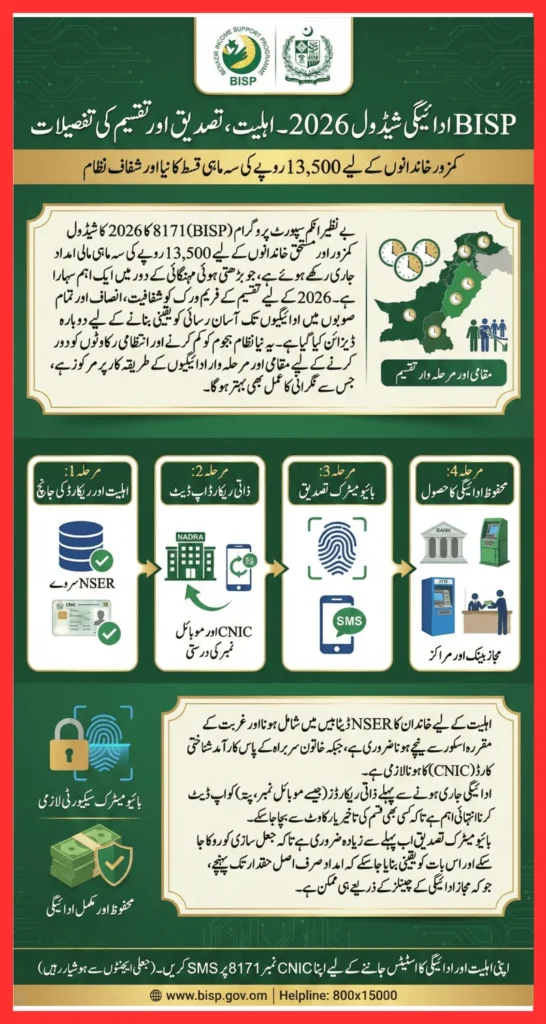
Not every household qualifies for BISP support. Eligibility is determined through a structured evaluation system designed to identify genuinely deserving families. To qualify in 2026, households must already be part of the BISP 8171 database and have completed the NSER (National Socio-Economic Registry) survey. This survey assesses income, household size, employment status, and living conditions. A valid CNIC is mandatory, and the registered woman must be alive and verified through NADRA records. Families falling below the approved poverty score threshold are considered eligible, while those with stable income sources or government employment are excluded. Special consideration continues for widows, persons with disabilities, and families impacted by natural disasters, ensuring social protection reaches those facing extreme hardship.
Importance of Updating Personal Records Before Payment Release
One of the most common reasons for payment suspension is outdated personal information. In 2026, BISP has tightened verification standards, making record accuracy more important than ever. If a beneficiary has changed their mobile number, residence, or CNIC details, these updates must be reflected in official databases. Any mismatch between NADRA and BISP records can result in temporary payment blockage. Beneficiaries are strongly advised to complete updates through authorized NADRA centers or BISP Tehsil Offices well before payment announcements to avoid unnecessary delays.
Simple Ways to Confirm Your BISP 8171 Payment Status
Checking payment status before visiting a collection point saves time and travel costs. BISP offers multiple official methods to verify installment availability. The most widely used method is SMS verification, where beneficiaries send their CNIC number to 8171 and receive an automated response regarding eligibility and payment status. This method works on basic mobile phones and is free of charge. Those with internet access can also verify details through the official BISP web portal, which provides real-time updates. Additionally, beneficiaries may contact the BISP helpline or visit nearby facilitation centers for guided assistance.
Approved Channels for Receiving BISP 8171 Payment in 2026
To improve accessibility, BISP continues to offer multiple authorized payment channels, allowing beneficiaries to choose the most convenient option. Regardless of the method, biometric verification is compulsory to ensure secure withdrawals. Payments can be collected through partner banks, mobile wallet services, and designated BISP centers. In some cases, funds are also transferred directly to linked bank accounts, reducing the need for physical visits. Beneficiaries should always ensure that they receive the full amount and obtain a receipt or confirmation message after withdrawal.
Also Read: BISP 13500 Payment 2026 CNIC & Thumb Verification Withdrawal Guide
Biometric Verification: Why It Matters More Than Ever
Biometric authentication has become the backbone of the BISP payment system. In 2026, fingerprint verification is mandatory for all beneficiaries to prevent impersonation and unauthorized withdrawals. If fingerprints fail due to age or health issues, beneficiaries should immediately report the problem at a BISP office. Alternative verification methods are available in exceptional cases, but delays may occur if issues are not reported promptly. Ensuring successful biometric verification not only guarantees payment security but also protects beneficiaries from exploitation by middlemen.
Common Problems Faced During Payment Collection
Despite system improvements, some beneficiaries may still encounter difficulties. Common issues include expired CNICs, fingerprint mismatches, incomplete surveys, or technical delays in system updates. In most cases, these problems are temporary and can be resolved by updating records or re-verifying information. Beneficiaries should avoid relying on unauthorized agents who demand extra charges, as BISP payments are entirely free. Reporting of issues through official channels ensures quicker resolution and prevents long-term payment suspension.
How BISP 8171 Strengthens Women’s Financial Independence
A defining feature of BISP is its focus on empowering women financially. By registering women as primary beneficiaries, the program ensures that financial aid directly benefits households. In 2026, this approach continues to improve women’s decision-making power within families, enabling better spending on nutrition, education, and healthcare. Over time, this contributes to broader social stability and poverty reduction.
Final Thoughts on BISP 8171 Payment Schedule 2026
The BISP 8171 Payment Schedule 2026 reflects a more structured, transparent, and beneficiary-friendly approach to social welfare distribution. With the quarterly Rs. 13,500 installment, millions of families can better cope with rising living costs and financial uncertainty.
By keeping personal records accurate, verifying payment status in advance, and using only authorized channels, beneficiaries can receive their funds smoothly and without deductions. The updated system not only improves efficiency but also strengthens trust in Pakistan’s largest social safety net program.
Also Read: Parwaz Card Registration Portal 2026 Online Application & Interest-Free Business Financing